

Content
How to sell to companies: inbound B2B marketing to shorten the sales cycle

B2B inbound marketing It is the strategy that allows companies to be found by other companies at the exact moment when they are looking for a solution. Unlike B2C, where the purchase decision can take place in minutes, sell to companies involves long cycles, multiple decision makers, ROI analysis and a level of trust that is only built over time.
Data from the Content Marketing Institute shows that companies with a documented content strategy generate 67% more leads than those that don't. And the DemandGen Report points out that 76% of B2B buyers expect content that speaks directly to their needs before talking to any seller.
This guide was written for directors, marketing managers, and CEOs who want to understand how to transform digital marketing into a predictable engine for generating B2B opportunities - without relying on cold prospecting, without burning money in campaigns without strategy.
Why is selling to companies different - and does it require your own strategy?
In B2C, the consumer sees an advertisement, feels the desire, and buys. The cycle can last minutes. In B2B, the reality is radically different. The purchase involves:
- Multiple decision makers: on average, 6 to 10 people participate in a B2B buying decision (Gartner, 2023).
- Long cycles: the B2B sales cycle can last from 3 months to over 1 year.
- Rational and ROI-based decision: the business decision maker must justify the investment internally.
- Perceived high risk: making a wrong choice of supplier in B2B can be costly.
This completely changes the marketing logic. Selling for companies requires education, nutrition, and authority positioning throughout the entire journey.
In B2B, marketing doesn't close the sale. It paves the way for the sale to take place with less friction, more confidence and in less time.
What is B2B inbound marketing and how does it work in practice?
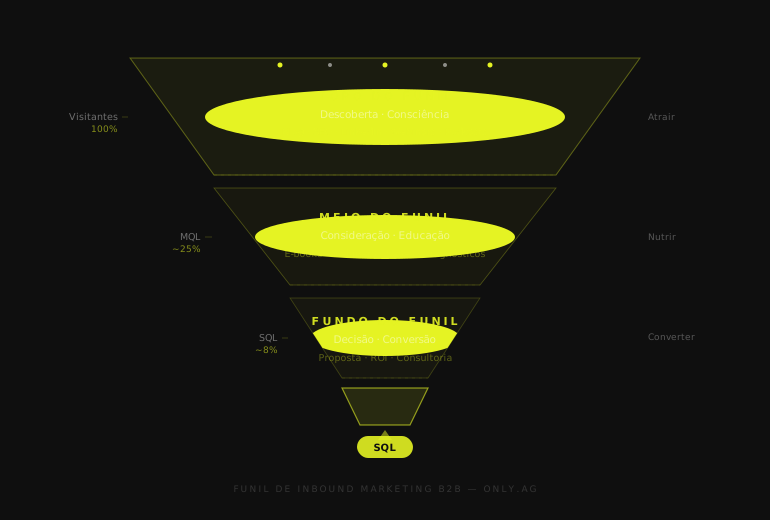
Inbound marketing is the methodology that attracts potential customers through relevant content, instead of interrupting them with invasive advertisements. In the B2B context, it works in four main steps:
1. Attract — Generate qualified traffic through SEO, blog, LinkedIn, webinars, and content that answers the real questions of your decision makers.
2. Convert — Turn visitors into leads through landing pages, forms, and value offers.
3. Nourish — Accompany the lead throughout the cycle with email marketing, automation, and content that advances their buying maturity.
4. Close and enchant — Deliver qualified leads to the sales team at the right time, and continue to generate post-sales value.
The great difference between inbound in B2B is that it create a predictable and scalable pipeline. Instead of relying on referrals or cold calls, the company is found organically by the right decision makers.

Who decides the purchase? How to map the stakeholders of the B2B cycle
One of the biggest mistakes in B2B marketing is creating content for a single persona when, in practice, the decision involves a committee. It is necessary to understand Who are the stakeholders in the buying process and what are your specific pains.
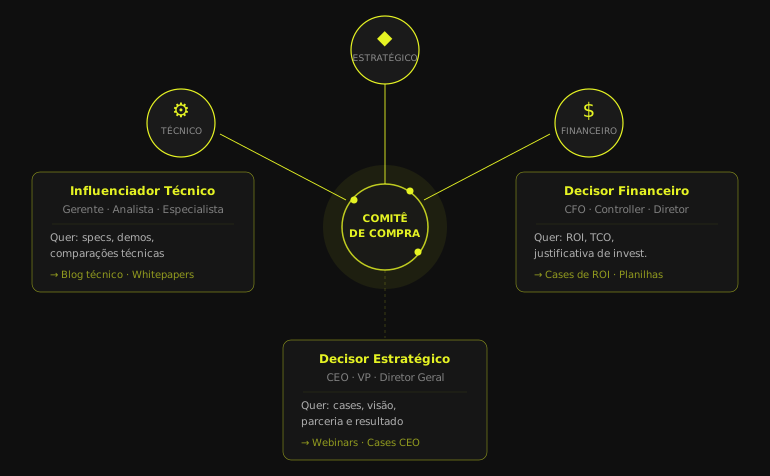
In a typical B2B sale, there are three main roles:
- The technical influencer: manager, analyst, or specialist who assesses whether the solution works technically. It wants specifications, comparisons, demos.
- The financial decision maker: CFO or director who approves the budget. You want ROI, TCO, and investment justification.
- The strategic decision maker: CEO or VP who defines whether the solution fits the company's vision. You want cases, vision of partnership, proof of results.
Effective B2B inbound creates content for each of these profiles. A technical article attracts the influencer. An ROI case convinces the financier. A webinar with a client's CEO enchants the strategic decision maker.

There is no single B2B persona. There is a buying committee. Your content strategy needs to talk to each of them.
How to attract decision makers with content: from the top to the bottom of the funnel
Content in B2B inbound needs to be mapped according to the lead's maturity stage. Each stage requires a different type of content, tone, and call-to-action.
Top of the funnel — Discovery and Awareness
The objective here is generate qualified traffic and create the first impression of authority. Ideal formats: SEO-optimized blog articles, LinkedIn posts, educational videos, podcasts, and market research.
Middle of the funnel — Consideration and Education
The objective is Position yourself as the best option and capture the contact. Ideal formats: e-books, whitepapers, webinars, case studies, comparisons, templates, free diagnostics.
Funnel Fund — Decision and Conversion
The objective is eliminate objections and facilitate closing. Ideal formats: cases with documented ROI, testimonials, demos, free consultancies, personalized proposals.
B2B lead nurturing: how to nourish and qualify without losing timing
One of the biggest losses of B2B marketing is generating a lead and not knowing what to do with it. According to Forrester Research, companies that nurture leads correctly generate 50% more sales opportunities with 33% less cost.
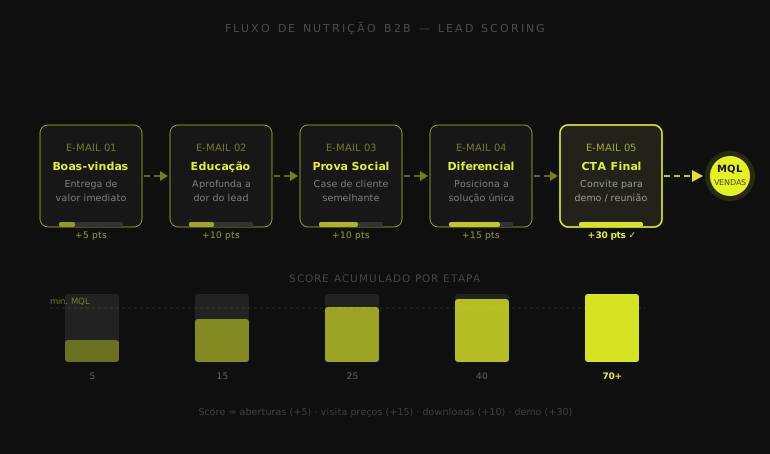
A well-structured B2B nutrition flow follows this logic:
- Email 1 — Welcome and immediate value delivery: thanks for your interest, delivers the promised material and briefly introduce the company.
- E-mail 2 - Education about the problem: deepens the pain that the lead is experiencing.
- Email 3 — Social proof: shares a customer case similar to the lead's profile.
- Email 4 — Competitive Differential: presents what makes the solution unique, without selling directly.
- Email 5 — CTA qualifier: invite for a conversation, demo, or diagnosis.
In parallel, the Lead Scoring Automates qualification: opened e-mail (+5 pts), visited the pricing page (+15 pts), downloaded a case (+10 pts), requested a demo (+30 pts). When the lead reaches the minimum score, it is passed on to the commercial team as MQL.
Unworked lead is wasted money. Nurturing transforms interest into opportunity—without relying on cold calling.
How to integrate inbound with CRM and sales team to close more contracts
One of the main bottlenecks of B2B operations is the misalignment between marketing and sales. The integration between inbound and CRM solves this problem by creating a unique pipeline visible to both teams:
- Joint definition of MQL and SQL: marketing and sales need to agree on what a qualified lead is.
- Full view of the lead history in CRM: the seller sees what content the lead consumed, what pages they visited, how many emails they opened.
- SLA between areas: marketing delivers X leads per month, sales address each MQL within 24 hours.
- Continuous feedback loop: sales returns information about objections and reasons for loss to marketing.

What metrics to monitor in a B2B inbound strategy?
Inbound marketing without measurement is art, not strategy. Metrics need to be tracked at each stage:
Top of the funnel — Attraction
- Total organic traffic and by channel
- Ranking of strategic keywords
- Bounce rate
- LinkedIn outreach and engagement
Funnel medium — Conversion
- Visitor to Lead (CVR) conversion rate
- Cost per lead (CPL)
- Volume of MQLs generated per month
- Open rate of nutrition emails
Funnel bottom — Closing
- MQL to SQL conversion rate
- Average sales cycle (in days)
- CAC (Customer Acquisition Cost)
- Total ROI of the strategy
B2B SEO: How to be found by the right decision makers on Google
SEO is the most efficient organic acquisition channel for B2B inbound in the long term. A well-ranked article continues to generate leads 24 hours a day, 7 days a week, with no additional media cost.
The terms with the highest commercial intent in B2B: “how to sell to companies”, “B2B inbound marketing agency”, “how to generate qualified B2B leads”. In addition to keywords, high-performance B2B SEO requires Topic Clusters, E-E-A-T and Technical SEO solid.
LinkedIn as a strategic channel in B2B inbound
LinkedIn is the platform with the highest concentration of B2B decision makers in the world. 80% of the B2B leads generated on social networks come from LinkedIn. In B2B inbound, it fulfills two roles: organic content distribution that generates authority, and segmented paid distribution by position, sector and company size with surgical precision.
How Only.Ag structures inbound marketing for B2B companies
Na Only.Ag, we don't believe in generic strategies. The B2B inbound marketing we develop begins with a direct question: What is the company profile you want to attract, and what does it need to hear before buying?
Based on this clarity, we built an integrated operation that connects content strategy and SEO, lead generation, nurturing automation, lead scoring, integration with CRM and metrics dashboard with a clear view of ROI.
Our B2B clients — from international universities to industrial groups — have transformed marketing into a predictable channel for generating opportunities. Not by luck. By method.
Your competitor is already being found by your customers. The question is: why not your company?
I want a B2B inbound marketing strategy →
FAQ — Frequently Asked Questions about B2B Inbound Marketing
How long does it take for B2B inbound marketing to generate results?
The first solid results usually appear between 3 and 6 months. Peak performance, with consolidated SEO and mature funnel, occurs between 12 and 18 months.
Does Inbound B2B Marketing Replace the Sales Team?
No. Inbound qualifies and warms leads, but the sales team is essential to conduct the negotiation and close the contract. Inbound and outbound work better together.
What are MQL and SQL in B2B?
MQL (Marketing Qualified Lead) is a lead with sufficient interest to be worked on by the marketer. SQL (Sales Qualified Lead) has been qualified by the sales team and is ready for direct approach.
What tool to use for B2B inbound marketing?
The most used: HubSpot, RD Station, ActiveCampaign (automation), Semrush or Ahrefs (SEO), Google Analytics 4 (analytics). The choice depends on the size of the operation.
How to sell to companies without relying on referrals?
Through structured inbound marketing: SEO to be found organically, content that educates and generates trust, landing pages that capture leads, and automation that nourishes the commercial approach until the right moment.
Schedule a free marketing consultation for your company.
Our experts are ready to help your business take off.

Receba nossos artigos exclusivos
Fique por dentro das nossas novidades e insights.