

Mídia e Performance
CAC, LTV and payback: how to know if your growth is truly sustainable

Higher revenue is not the same as growing well. Many e-commerce operations increase revenue month after month while margin shrinks, cash tightens and each new customer costs more than it returns. Growth exists, but it does not sustain itself.
Three metrics reveal the difference between the two scenarios: CAC, LTV and payback. In this article, we explain what each one measures, how they relate and why, in the current context of Brazilian e-commerce, they have become even more decisive.
The 2026 scenario demands looking beyond revenue
According to the report "Da Compra à Confiança", produced by Confi in partnership with E-commerce Brasil and presented at Fórum E-Commerce Brasil in July, the sector moved R$ 208.4 billion between January and June 2026, a 16.9% year-over-year increase. There were 756.7 million orders in the period, 34.8% more than a year earlier, while the average order value stood at R$ 275.50, a 13.3% decline.
The reading is clear: more orders, smaller ones. Brazilians are buying online more often, but with leaner carts. In this environment, acquiring a customer for a single low-ticket purchase rarely pays the bill. The return depends on repeat purchases, retention and long-term relationships. That is exactly what CAC, LTV and payback measure.
What is CAC (Customer Acquisition Cost)?
CAC is how much the company invests, on average, to win a new customer. The basic calculation adds up all marketing and sales spend in a period and divides it by the number of new customers won in that same period.
The most common mistake is underestimating the numerator. An honest CAC includes paid media, tools, agency, team, content production and commissions. Another caution: separate new customers from repeat purchases. Mixing the two artificially inflates the denominator and hides the real cost.
What is LTV (Lifetime Value)?
LTV is the revenue, or rather the margin, a customer generates over the entire relationship with the brand. A practical way to estimate it: average ticket multiplied by purchase frequency in a period, multiplied by average retention time, applying the contribution margin to the result.
Calculating LTV on gross revenue is a frequent trap. A customer who buys R$ 2,000 a year in low-margin products is worth less than one who buys R$ 800 in high-margin products. It is margin that pays the CAC.
What is payback?
Payback is the time the company takes to recover CAC with the margin generated by the customer. If CAC is R$ 150 and each customer generates R$ 30 of margin per month, payback is five months.
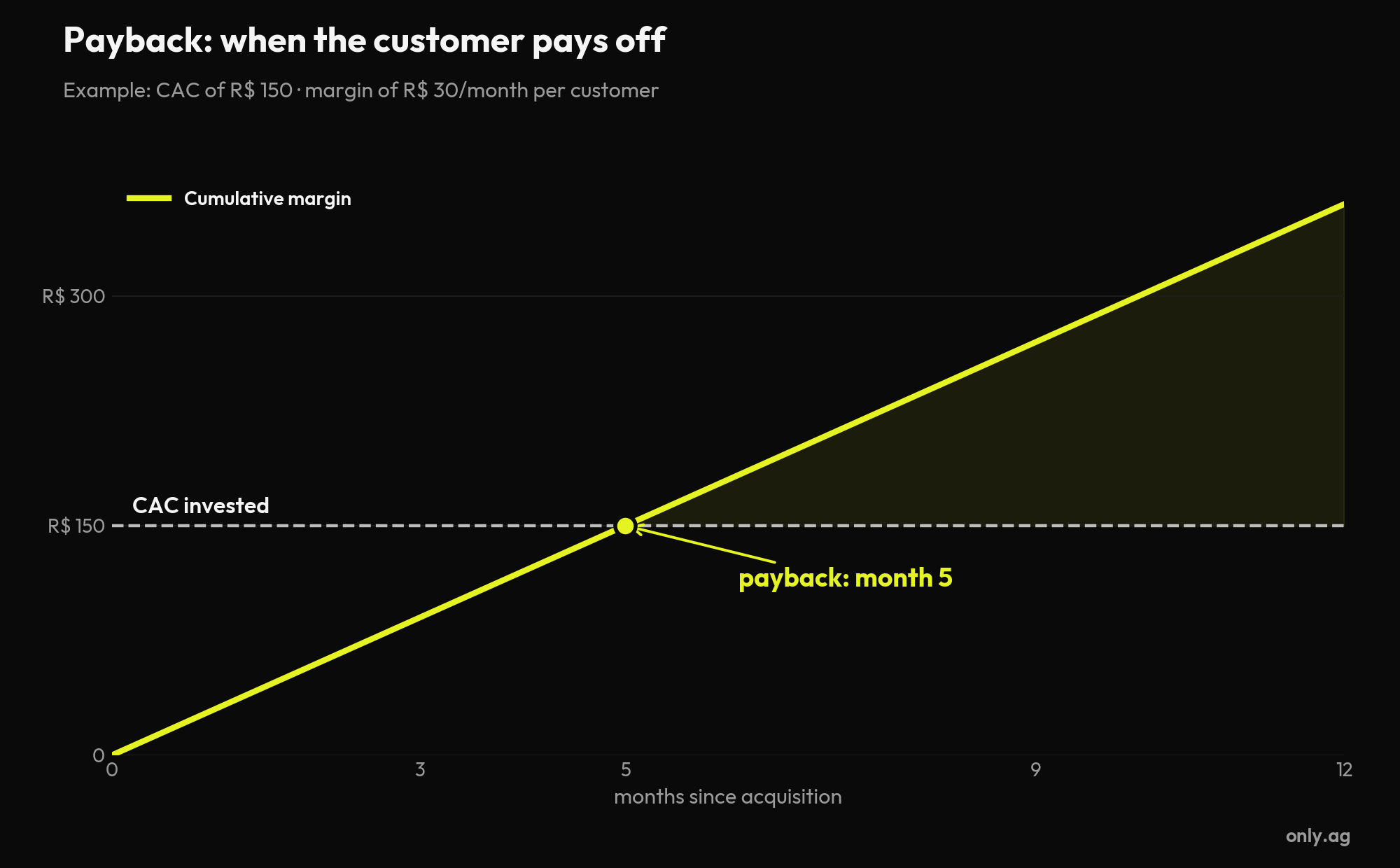
This is the metric that connects growth and cash. A high LTV with a long payback can be profitable on paper and unsustainable in practice, because the money invested in acquisition stays locked for months. In operations that depend on working capital, short payback is what allows reinvesting and accelerating.
How to know if growth is sustainable: 4 signs
None of these metrics works alone. What indicates health is the relationship between them:
- LTV/CAC ratio. Shows how many times the customer’s value exceeds the cost of winning them. A ratio below 1 means every acquisition loses money. Ratios close to 1 indicate the operation is just exchanging money. The wider the gap, the more room to invest safely. The ideal level varies by category, margin and repurchase cycle, and should be defined from the operation’s own data
- Payback compatible with cash. The recovery period must fit the business’s financial capacity, especially in heavy investment periods, such as Black Friday preparation
- Trend over time. CAC rising with stable LTV is a warning sign. LTV rising with controlled CAC signals the operation is building a base, not just buying volume
- Segmentation by channel and by cohort. Averages hide problems. One channel may bring cheap customers who never return, while another brings expensive customers who stay for years. Analyzing by origin and acquisition cohort reveals where growth is real
Levers to improve all three metrics
Reducing CAC involves sharper segmentation, creatives that qualify before the click, landing page optimization and a results-oriented channel mix. Increasing LTV involves CRM, recurrence, cross-sell, loyalty programs and a post-purchase experience that drives repeat buying. Shortening payback involves improving first-purchase margin and accelerating the second purchase.
The central point is that these levers must operate together. Cutting media to lower CAC without working on retention only reduces growth. Investing in loyalty without controlling acquisition drains cash.
How does Only work in this scenario?
Our job is to make brands grow with results, which means looking at CAC, LTV and payback as a system, not as isolated numbers on a dashboard.
In practice, that involves structuring measurement so the metrics reflect the operation’s reality, connecting paid media, CRM and data into a single strategy, and continuously reviewing investment allocation based on the real return each channel and each cohort delivers.
Frequently asked questions about CAC, LTV and payback
How do I calculate CAC?
Add up all marketing and sales investments in a period (media, tools, agency, team, content and commissions) and divide by the number of new customers won in the same period. Repeat purchases stay out of the calculation.
What is a good LTV/CAC ratio?
Below 1, every new customer loses money; close to 1, the operation is just exchanging money. Above that, there is no universal number: the healthy level depends on margin, category and repurchase cycle, and should be defined with the operation’s own data.
What is the difference between LTV and revenue?
Revenue is the gross amount the customer buys. Well-calculated LTV applies the contribution margin to that amount over the relationship. It is margin, not revenue, that pays the acquisition cost.
What is payback in marketing?
It is the time needed for the margin generated by a customer to cover the investment made to win them. Short payback frees cash to reinvest; long payback can stall growth even with high LTV.
Results and nothing else.
Find out if your growth sustains itself
If you do not know precisely how much each customer costs, how much they return over time and how long the investment takes to come back, your operation’s growth is flying without instruments.
Only offers a free analysis meeting: we assess your acquisition and retention metrics, identify where margin is being squeezed and point out the opportunities to grow sustainably.
Book your free analysis and turn growth into results →
Read next
Schedule a free marketing consultation for your company.
Our experts are ready to help your business take off.

Receba nossos artigos exclusivos
Fique por dentro das nossas novidades e insights.